
 The Murderous Maths Sieve of Eratosthenes
The Murderous Maths Sieve of Eratosthenes
The Murderous Maths Sieve of Eratosthenes

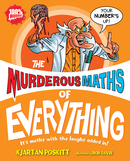
In The Murderous Maths of Everything we meet several ancient Greek mathematicians including ERATOSTHENES. Eratosthenes did lots of rather neat things, but he's best known for his method of finding prime numbers. This is called the Sieve of Eratosthenes.
This is our version of the sieve as it appears in the book, but here we're going to show you a couple of extra details that the book didn't have space for.
We're going to find all the prime numbers up to 100. We start by writing them out in a square grid, and then we work along the numbers and “sieve” out all the numbers that are not prime.
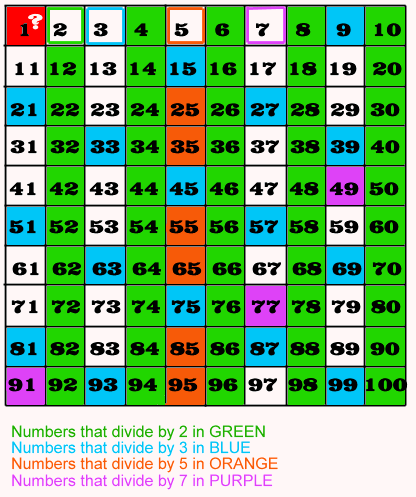
Why don't we need to work beyond the top row of the square? If we move on to the next unmarked number, we find it's 11. If we boxed it and then tried to colour the first unmarked number that divides by 11, that would be 11 x 11 = 121. This is bigger than 100 so we don't need it! That's why we started out by putting our numbers in a square. Once we've finished working along the top row, we can be confident that it's time to stop!
Why did we ignore the number 1? In the book you'll see how the EVIL NUMBER 1 causes all sorts of problems, especially with prime numbers. If we boxed the number 1 then coloured in every number that divides by 1, we'd end up colouring in ALL the numbers! That wouldn't get us very far so that's why we ignored it.
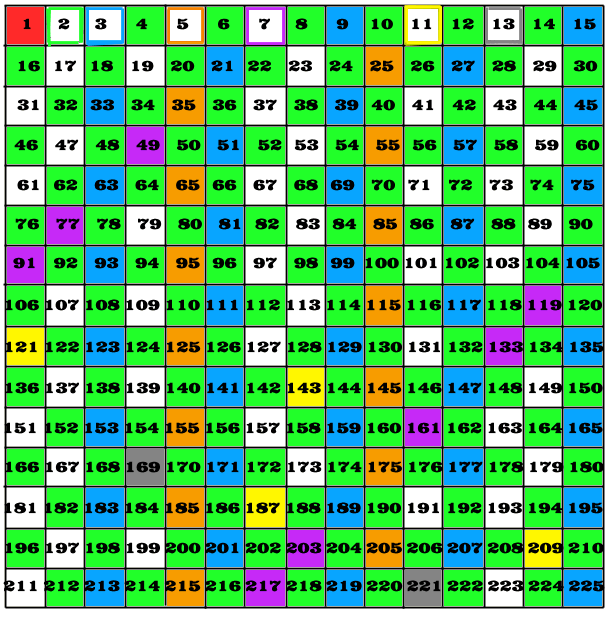 If you wanted to find all the primes up to 200, you need to make a square measuring 15 x 15. (This will actually give you all the primes up to 225.) You just work along the top row in the same way, and when you've finished all the primes will be revealed!
If you like numbers (and some people do!) it's interesting to see the odd little patterns that emerge when you make these grids. Here you'll notice how the green "2" boxes form a chequerboard pattern and how the purple "7" boxes are all in diagonals...
...but the thing that has been bothering mathematicians for thousands of years is that it doesn't matter how the number grid is laid out, they can't make the white prime boxes fall into ANY kind of pattern!