PRIME NUMBERS
Before we start with the fun (which involves a trick and a special prime number calculator),
there's just one thing you need to know:
Prime numbers are numbers that can only
be divided by themselves or by 1.
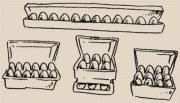
12 is not a prime number because it will divide by 1,2,3,4,6 and 12.
This means that if you have 12 eggs, there are several different shaped
boxes you can neatly fit them all into.
|
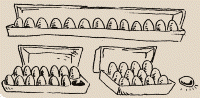
13 is a prime number because it will only divide exactly by 1 or 13. If you have 13
eggs, the only box they will neatly fit into has one row of 13 eggs. If you try
boxes that are shorter and wider, you'll never neatly fit all 13 eggs in.
|
The prime numbers smaller than 100 are:
2, 3, 5, 7, 11, 13, 17, 19, 23, 29, 31, 37, 41, 43, 47, 53, 59, 61, 67, 71, 73, 79, 83, 89, 97 ...
...and they go on for ever. So far nobody has found a pattern to predict them
and they can't decide if 1 is prime or not!
|
 Mathematicians LOVE prime numbers because just
about all of maths is made out of prime numbers.
In the same way, scientists LOVE atoms because just about
everything we know is made out of atoms.
Mathematicians LOVE prime numbers because just
about all of maths is made out of prime numbers.
In the same way, scientists LOVE atoms because just about
everything we know is made out of atoms.
You can find out how the ancient Greeks found prime numbers up to 100 and beyond using the Sieve of Eratosthenes.
So now we know what prime numbers
are, what can we do with them?
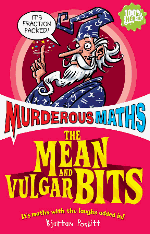
- Smashing big sums to bits! If you've read The Mean and Vulgar Bits then
you'll know how to use prime numbers to make ugly divisions and fractions
a lot easier.
- Secret Codes! Some of the toughest codes in the world are made using
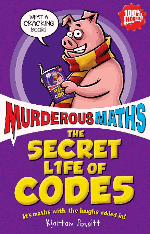
mega prime numbers. You can find how this works in The Secret Life of Codes. There's even a VERY simple prime code in the
original Murderous Maths book.
- A good trick....
Before we see the trick, here's a neat toy for you to try.
It's a special
calculator which can tell you if a number is prime or not.
All you need to do is type a number in the box, and then
hit the ACTIVATE button.
(Warning: if you put in numbers with lots and lots of digits your
computer might get a bit cross!)
Have you tried it out?
What's the BIGGEST prime number you can find?
The Prime Number Trick
Using prime numbers, you can amaze your friends with a prime prediction...
- Ask your friends to pick any prime number bigger than 5, but they must not tell you what it is.
- Square it. (In other words multiply the prime number by itself.)
- Add 17
- Divide by 12
Without knowing which prime number your friends picked, you can still tell them:
There will be a remainder of 6.
(Or if they do the sum on a calculator, the answer will end with " .5")
If you want to try this out yourself right now, use the Prime Number Calculator
to find a nice big juicy prime number.
Put your number into this normal calculator (you need to push the buttons with your mouse).
First you multiply your prime number by itself then add 17 and finally divide by 12.
What do you get?
|
For example, if you want to try the trick with the prime number 2801, here's what to push:
2801 * 2801 =
+ 17 =
/ 12 =
...and that's the answer! Now find a new prime number and try it.
The "24" Mystery!
A Murderous Maths fan called OBAID pointed out that if you square ANY prime number bigger then 3, then subtract 1, the answer always divides by 24!
E.g. 112 = 121 then 121 - 1 = 120 and yes 120 does divide by 24.
WHY?
If you understand algebra, (and you've read The Phantom X ) then you'll know that all prime numbers can be written as (6n+1) or (6n-1).
(6n+1)2 = 36n2+12n+1. So (6n+1)2 -1 = 36n2+12n. This factorises to 12n(3n+1).
Either n or (3n+1) must be even, therefore the whole expression must be
divisible by 24.
(6n-1)2 = 36n2-12n+1. So (6n-1)2 -1 = 36n2-12n. This factorises to 12n(3n-1).
Either n or (3n-1) must be even, therefore the whole expression must be
divisible by 24.
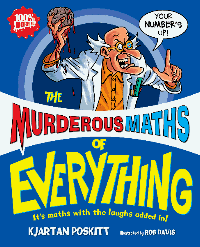
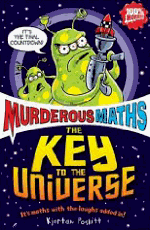
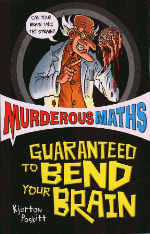
Find out more about prime numbers in these Murderous Maths books:
|
 |
 |
 |
 |
 |
|
- How to find prime factors
- How to make fractions cancel
- How to find the Highest Common Factor (HCF) and Lowest Common Multiple (LCM)
|
- Mersenne Primes and perfect numbers
- How to check for primes
- Proof that there are an infinite number of primes
- Goldbach's conjecture
- Is 1 prime?
|
- Simple introduction to primes
|
- How huge primes are used in RSA code used for sending credit card numbers over the internet!
|
Learning prime numbers can even help you master games like blackjack, giving you a better chance of winning.
You can take things even further by learning a system known as card counting, which actually gives players the opportunity to beat the casinos at their own game.
|
|